
Layer 2 of the PX framework calls for an ideal project environment for an individual to grow. A project needs the following ingredients for this growth environment:
- ‘Balanced’ psychological safety
- Flexibility to exercise autonomy.
- Opportunities for mastery.
We have already discussed the importance of psychological safety in an organization. Psychological safety creates an environment where the individual feels safe. Safe enough to share her ideas and be creative without fear. Fear of retribution, admonition, and criticism.
Now the challenge is how do you get high-quality motivation? When are you immersed in a task and have the best experience and performance? Enters the next two ingredients of layer 2 – autonomy and mastery.
Dr. Edward Deci and Dr. Richard Ryan tasked two groups of Psychology students to solve a Soma cube puzzle. Only one of these two groups was paid if they solved the puzzle. When the allotted time was over, which group do you think was more likely to stay engaged with the puzzle? Staying engaged would be a sign of high-quality motivation). The group paid for solving the puzzle (i.e., extrinsic reward), drifted into other activities.
In contrast, the group that was not paid (i.e., intrinsic reward) was likelier to continue with the puzzles. People who were paid money no longer experienced that intrinsic motivation. This experiment was the foundation of the Self-Determination Theory (SDT) of motivation.
SDT theory explains how the level of self-determination impacts motivation. Motivation is better when it is intrinsic. People are more driven to act when they believe their activities will impact the outcome.
Monetary incentives do not influence tasks involving higher-order thinking. These tasks involve creativity, cognitive skills, decision-making, critical data analysis, etc.
Deci and Ryan published “Intrinsic Motivation and Self-Determination in Human Behavior” in 1985. They proposed three basic psychological needs to achieve the highest quality of motivation. Those needs are:
- Autonomy: Individuals need control over their affairs, behaviors, and goals.
- Competence: An individual needs to learn, grow and achieve mastery & skills.
- Relatedness: An individual needs to feel a sense of belonging in a group.
Daniel Pink echoed the same formula for effective motivation. In his 2009 book ‘Drive’, Pink asserted that effective motivation is largely intrinsic. He proposed a three-ingredient recipe to optimize the ‘drive’ within the employees.
These are Mastery, Autonomy, and Purpose. Human wants to work on something that serves a ‘purpose’ higher than themselves. She wants to have control over her affairs (i.e., autonomy) while pursuing this purpose. She wants to grow (i.e., learn and achieve ‘mastery’) in the process.
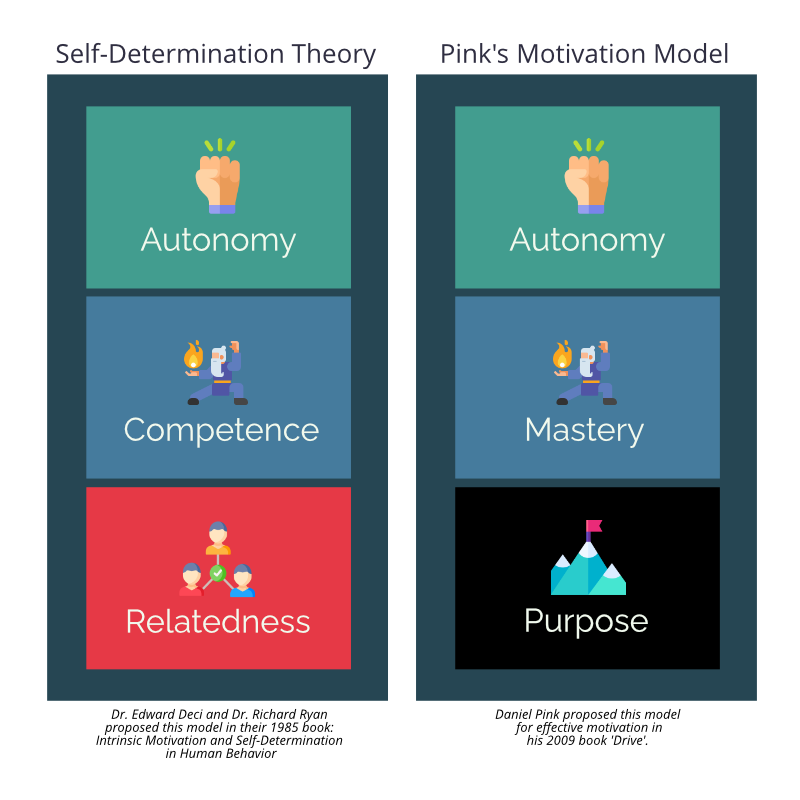
Between Deci & Ryan’s Self Determination Theory and Pink’s MAP model, six elements motivate employees. They are:
- Autonomy or agency,
- Competence or mastery,
- Relatedness,
- Purpose.
The first layer of PX includes clarity of purpose, a fundamental requirement for an inspirational experience. The second layer calls for setting up an ideal environment for growth. A combination of psychological safety, autonomy, and opportunities for mastery form the motivational foundation for growth. Once a worker feels safe and sees the opportunities for growth then teamwork becomes relevant and important. This is the reason ‘relatedness’ went into layer 3 of the PX model.
References:
- The intrinsic motivation of Richard Ryan and Edward Deci
- How Does Self-Determination Theory Explain Motivation?
- What Is Self-Determination Theory?
- Drive: The Surprising Truth About What Motivates Us by Daniel Pink
- DRIVE: The Summaries
- The Gamification principles within Daniel Pink’s Book, Drive
- What Is the Sense of Agency and Why Does it Matter?
Credit: Photo by Jan Valečka on Unsplash


