
Can a project be more successful if the team goes through positive experiences? What are these positive experiences, and can they be designed?
Is it Hope’s fault?
Hope started as a construction manager in a cell tower project about four months ago. She joined the project with an impressive resume. Hope is honest and works hard to meet her timelines. But there are too many moving parts, and she feels exhausted from juggling all the balls.
Self-proclaimed ‘old-timer’, Glen, the project manager, is a no-nonsense, all-business, tough guy. He is obsessed with balancing the project’s speed, budget, and quality. Despite her hard work, Hope can’t shake off this nagging feeling that Glen will let her go if she does not perform. Hope is working in a competitive, performance-based environment. Unfortunately, She does not feel connected to her team either. She won’t be surprised if her colleagues throw her under the proverbial bus.
Hope told her mentor (Richard) about her mental state and asked for his advice. Richard advised her to keep her head down and grind away. ‘It’s a typical, fast-moving project environment’, said Richard.
Do you think her stressful experience is her weakness? Maybe.
I would argue, though, her mental state is a product of the project. We can design a project environment to produce a set of positive experiences. Hope will be more creative, inspired, and motivated in such a surrounding. This optimized setting will bring out her best performance.
Human-Centered Project Management (HCPM)
We call a project a success when it’s completed within budget, time, and expected quality. Successful project management is more than that. At the end of the project, you want the project team to grow positively. Get inspired and energized by the complexity of the project. Get motivated (and even hungry) to take up the next challenge.
It’s rare to find artifacts on project management that address human experience within a project, and it’s implicit in most cases. The real goal should be to minimize cognitive expenses. Maximize inspiration and motivation.
That’s a daunting goal, but that’s what HCPM wants to tackle. HCPM stands for Human-Centered Project Management, a framework that focuses on the human experience of the stakeholders. In most projects, there is a lot of focus on the customer’s experience. But a pleasant experience for the project workers is a prerequisite for an excellent experience for the customer.
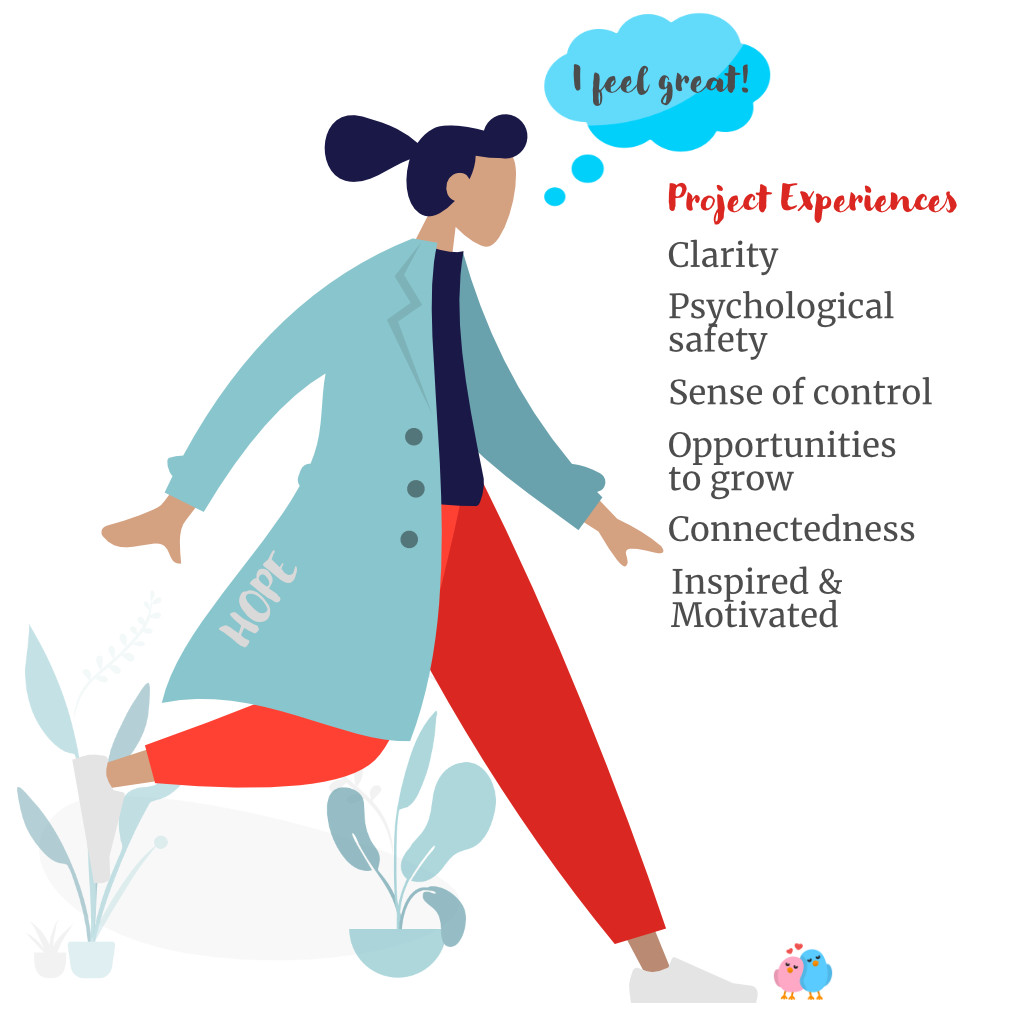
If Hope worked in an HCPM environment, she would go through the following experiences.
1. Clarity: Hope understands the project’s purpose. She can envision the challenging but achievable road to success. She knows what the project expects from her and when.
2. Balanced Psychological Safety. Hope feels safe and respected. She can share her ideas without any fear of ridicule. Her project is a harmonious system of safety, accountability, and productivity.
3. Sense of agency or control. She has power and a sense of agency over her daily work. She is not micro-managed.
4. Freedom to grow. She can learn and grow in this project.
5. Sense of belonging and connectedness. The project team shares and surrounds her with a safety net. She knows the team has her back and will pull her along if she struggles once in a while.
6. Inspired & motivated. Once primed with the five experiences above, Hope will experience inspiration and motivation. She will be proud to be on this project because it adds to her self-worth. She is eager to perform and complete the project. Fearless to take up the next challenge.
HCPM Components
HCPM adds experience management to traditional project management. Two components – Project Experience (PX) and Project Interface (PI) – make up the HCPM framework.
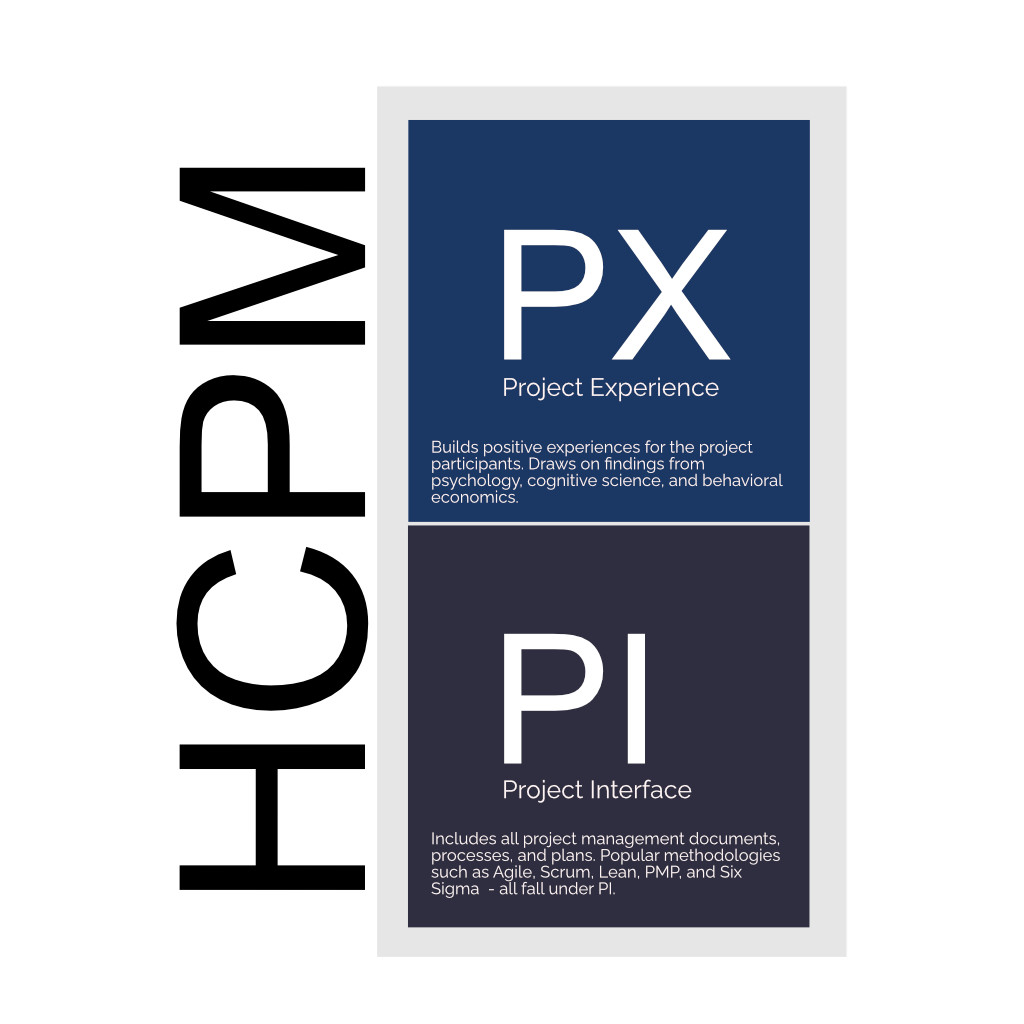
I derived PX & PI from the concepts of UX & UI. Don Norman first coined the term “user experience” in the late 1990s. Don is a cognitive scientist and the author of “The Design of Everyday Things”. According to Wikipedia:
The user experience (UX) is how a user interacts with and experiences a product, system or service. It includes a person’s perceptions of utility, ease of use, and efficiency.
Source: Wikipedia
UX applies to any product you can experience, whether a website, cell phone, vacuum cleaner, or pots & pans.
PX is the experience an individual goes through while working on or with a project. The PX component of HCPM designs positive experiences. PX draws on findings from psychology, cognitive science, and behavioral economics. Our focus on this site will be PX.
Project Interface (PI) includes conventional project management documents, processes, and plans. PI addresses the three classical factors of projects – time, budget, and quality. So, all project management methods (such as Agile, Scrum, Lean, PMP, Six Sigma, etc.) fall under the PI framework.


