
In the last blog, I showed Human Centered Project Management has two components. PX & PI. This post is on PX. PX stands for Project Experience. With PX, we design the experiences we want the project stakeholders to go through. The project stakeholder is affected by a project’s decision, activity, or outcome.
PX draws on findings from psychology, cognitive science, and behavioral economics. At a high level, PX has four states. These states are
- Achieve clarity: Provide clarity of purpose, plans, processes, and people (and their roles).
- Create a safe environment for growth: Establish psychological safety. Ensure flexibility to exercise autonomy. Provide opportunities for mastery. Build a guided system of productivity.
- Increase connectedness: Increase team cohesion and teamwork through an increased sense of belonging.
- Reach the state of inspiration: At this stage, stakeholders become motivated and energized. Participants engage in creative problem solutions and reach the productivity multiplier. They are eager to finish the current project and take on the next challenge.
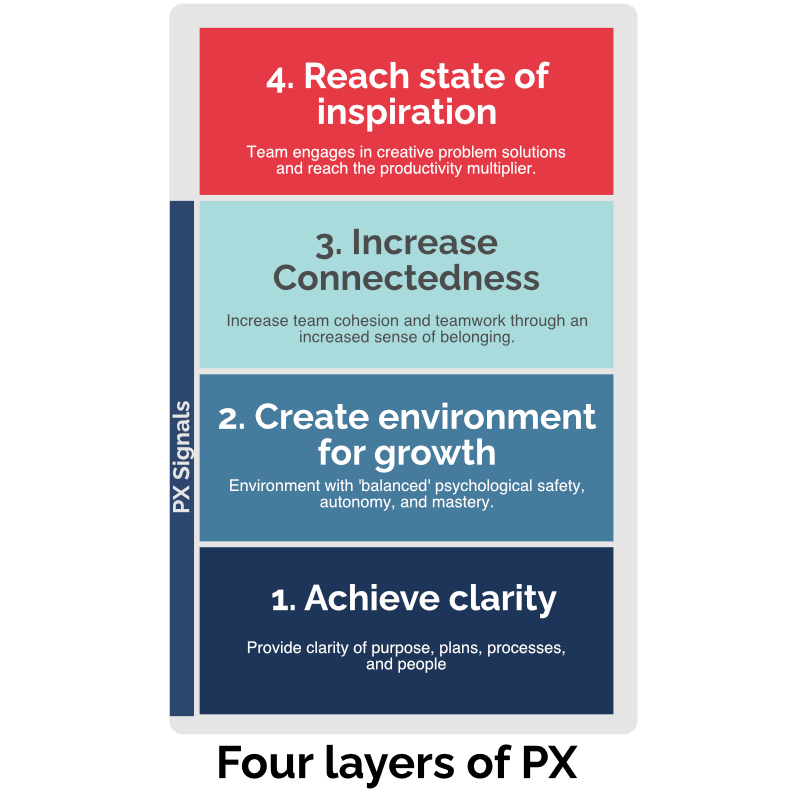
PX-Signals
The two most significant challenges in implementing the PX framework are
1. Projects are time bound and short-lived. The overwhelming focus is managing budget and quality. Project managers can argue that they don’t have time for PX.
2. Most projects involve collaboration between several companies. These companies have different cultures. Defining and implementing a common PX culture will be challenging.
PX-signals combat these obstacles. Signals are crucial for the execution of the PX framework and are much more than the typical project communication plan. Signals combine listening, observing, and constantly (psychologically) nudging the team toward the layer of inspiration. These ‘nudges’ can be through many channels. Channels can be conversations, meetings, emails & messages, environmental set-ups, gamification of projects, etc.
Signals let the team know they are psychologically safe; they have the flexibility of autonomy and the freedom to learn and be creative. They are the optimistic messages that keep hope alive through difficult times and psychological nudges that keep the team inspired, motivated, and energized.
Credit: Photo by Qingbao Meng on Unsplash


