Balance psychological safety with a system to enhance accountability.
Psychological Safety has to be balanced by a system of accountability. Of course, you want people with a strong sense of responsibility in your project. Assuming that you have that pre-requisite fulfilled, you should put a system that nurtures and develops accountability.
I have worked with intelligent, conscientious people whose problem is not lack of dedication, hard work, or honesty. But they do get distracted, lose track of the priority of work, and miss deadlines. They feel inadequate and beat themselves up for falling behind; this is where Guided Productivity System (GPS) comes into play. The guided productivity system helps these honest and hard-working people to stay on track.
GPS is an extension of Psychological Safety. Project Managers can design the GPS to maximize the strength of the people and give system-based support where they might be weak. In the end, it keeps the PX score high.
The word ‘accountability’ can be abstract. Before I dive into the GPS, let me quickly define ‘accountability’ so that we are on the same page.
Accountability
Accountability has two parts:
- Foundation (ownership)
- Going above and beyond
At the foundation, a project worker with accountability will take ownership or accept responsibility for his actions. He is mindful of what the project expects of him. He meets deadlines and expectations. He pays attention to details. When he realizes his mistakes, he has the humility to acknowledge and fix those mistakes.
An accountable individual respects his teammates and will show up for their actions. He is punctual at meetings and discussions – because he respects others’ time and presence.
In addition to the traits mentioned above, an accountable person goes above and beyond his expectations. He shows initiative and takes on extra tasks to help others out. He helps his fellow workers because he understands his impact when he helps his co-workers. When problems arise, instead of just complaining, he offers solutions. He doesn’t wait for problems to appear; he will proactively anticipate and work toward a solution.
Finally, a person with accountability demonstrates leadership by setting examples, helping others, and holding teammates accountable. He stands up for what’s right. Hopefully, the project will harvest the proper psychological safety to support him when he voices his opinion.
Being accountable improves confidence, performance, and connections with others. A sign of a person with high accountability is when the team loves to be around you and work with you.
Guided Productivity System (GPS)
Principle #5 of the 12 guiding principles (i.e., Agile Manifesto) that help teams in executing with agility says:
“Build projects around motivated individuals. Give them the environment and support they need, and trust them to get the job done.”
Source: The Key Values and Principles of the Agile Manifesto
GPS is one such system.
There are typically three components of a GPS:
- A system that tracks progress milestones, for example, a project tracker
- Maintaining regular, consistent, and quality project meetings, daily or weekly.
- Timely and clear feedback to the project workers
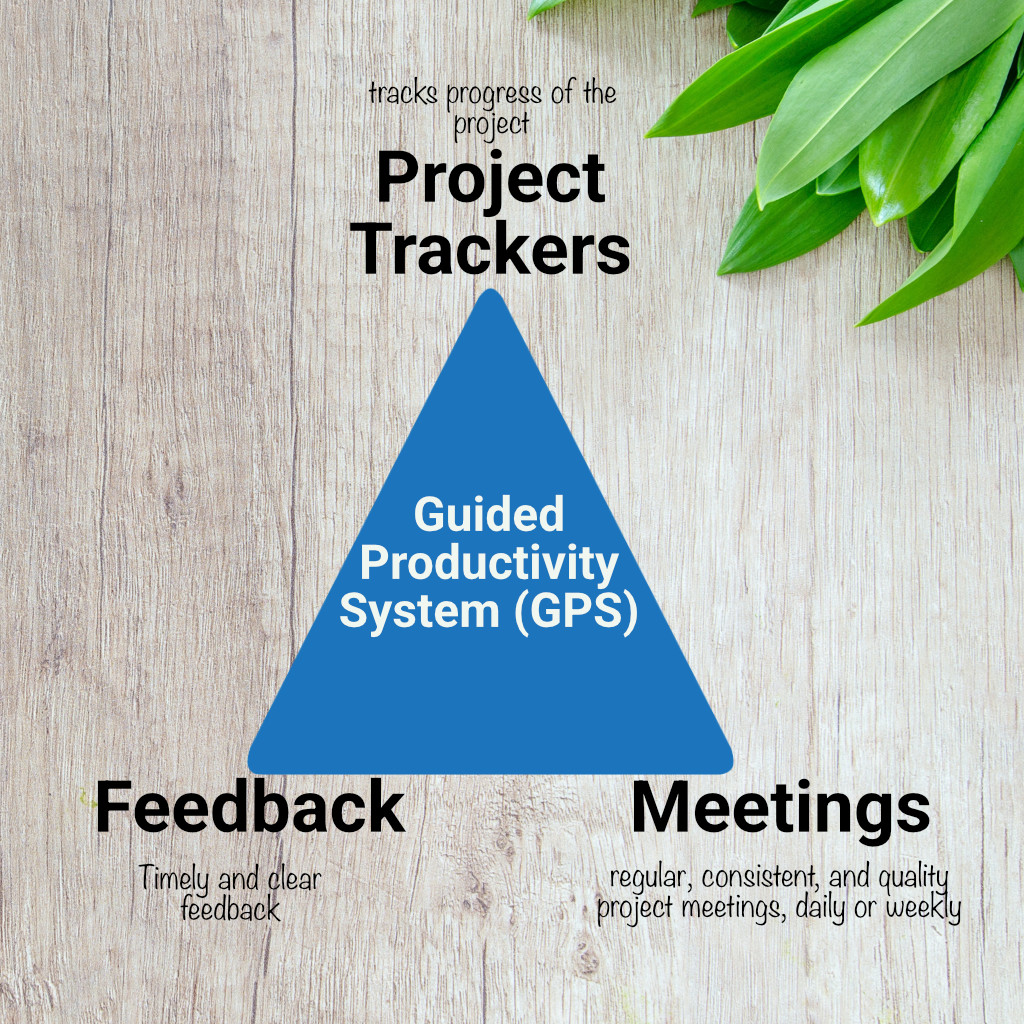
For years, my go-to GPS had been a combination of project trackers (i.e., progress reports) and weekly or daily meetings. In future posts, I will discuss trackers, meetings, feedback, and my experience with them. I want to mention three of the four disciplines of execution mentioned in the book “The 4 Disciplines of Execution: Achieving Your Wildly Important Goals” by Chris McChesney et al. The four disciplines mentioned in this form the foundation of an execution culture.
GPS and Disciplines of Execution:
Discipline 2 calls for acting on Lead Measures. Lead measures are critical activities that lead to lag measures (i.e., goals). For example, if you are trying to lose 10 pounds in 2 months, losing ten pounds will be the lag measure, whereas daily walking and cutting carbs from the diet will be two of the lead measures. Project trackers should include lead and lag measures in the form of milestones.
Discipline 4 invites the creation of a “Cadence of Accountability .” Each team engages in a simple weekly process that highlights successes, analyzes failures, and course-corrects as necessary, creating the ultimate performance-management system.”
The 4 Disciplines of Execution has Discipline 3 that asks to keep a compelling scoreboard because, if appropriately designed, scoreboards tap into human emotional energy; it motivates people to perform. A good project tracker should incorporate measurable scores. Despite the apparent benefit of a scoreboard, use the score collection cautiously. A scoreboard-driven culture can expel intrinsic motivation from the motivational equation (see the post on Self-Determination Theory). I will blog about my experience using Scoreboard (examples of Telecom Installation Services) and why I use it sparingly in creative projects.
I mentioned before that GPS is an extension of Psychological Safety. As you can see from the above discussion, GPS also works as a foundation of an execution culture.
Reference:
- What is Accountability in the Workplace?
- The 4 Disciplines of Execution: Achieving Your Wildly Important Goals” by Chris McChesney et al.
- The 12 Principles behind the Agile Manifesto
Image Credit:
- Photo by eberhard ? grossgasteiger on Unsplash
- Photo by Lukas Blazek on Unsplash (collage by me)


