Collaborythm

Four layers of the PX framework

Setting up a project for the best experience: Four states of PX

In the last blog, I showed Human Centered Project Management has two components. PX & PI. This post is on PX. PX stands for Project Experience. With PX, we design the experiences we want the project stakeholders to go through. The project stakeholder is affected by a project’s decision, activity, or outcome.

PX draws on findings from psychology, cognitive science, and behavioral economics. At a high level, PX has four states. These states are

  1. Achieve clarity: Provide clarity of purpose, plans, processes, and people (and their roles).
  2. Create a safe environment for growth:  Establish psychological safety.  Ensure flexibility to exercise autonomy. Provide opportunities for mastery. Build a guided system of productivity.  
  3. Increase connectedness:  Increase team cohesion and teamwork through an increased sense of belonging. 
  4. Reach the state of inspiration: At this stage, stakeholders become motivated and energized. Participants engage in creative problem solutions and reach the productivity multiplier. They are eager to finish the current project and take on the next challenge.
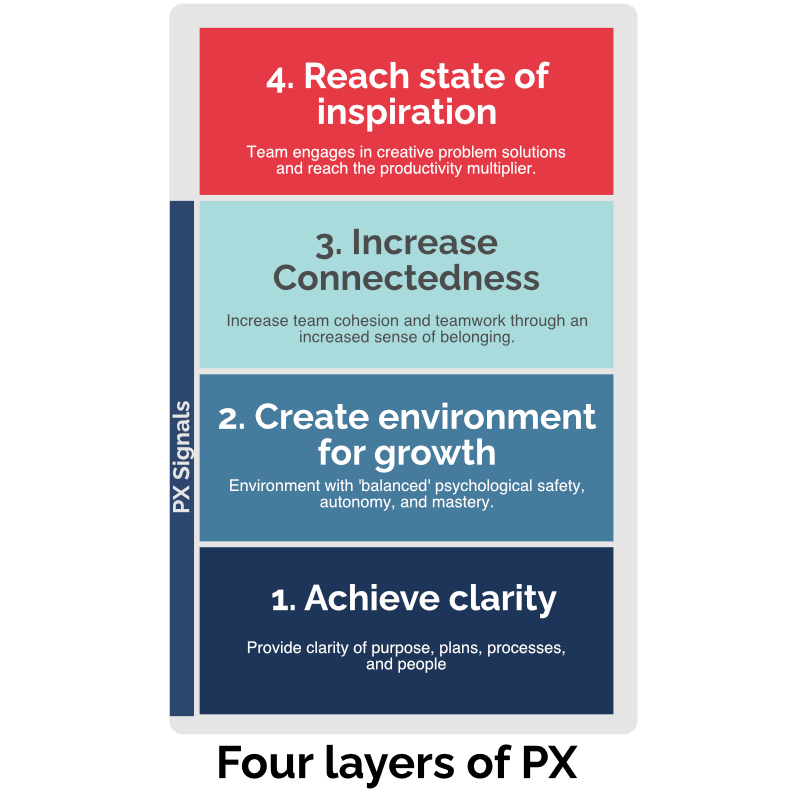
Four layers of PX

PX-Signals

The two most significant challenges in implementing the PX framework are  

1. Projects are time bound and short-lived. The overwhelming focus is managing budget and quality. Project managers can argue that they don’t have time for PX.

2. Most projects involve collaboration between several companies. These companies have different cultures. Defining and implementing a common PX culture will be challenging. 

PX-signals combat these obstacles. Signals are crucial for the execution of the PX framework and are much more than the typical project communication plan. Signals combine listening, observing, and constantly (psychologically) nudging the team toward the layer of inspiration.  These ‘nudges’ can be through many channels. Channels can be conversations, meetings, emails & messages, environmental set-ups, gamification of projects, etc. 

Signals let the team know they are psychologically safe; they have the flexibility of autonomy and the freedom to learn and be creative. They are the optimistic messages that keep hope alive through difficult times and psychological nudges that keep the team inspired, motivated, and energized.

Credit: Photo by Qingbao Meng on Unsplash

Latest Posts

The Science of Workspace Magic

Transform Your Office into a Haven of Inspiration and Teamwork John Thompson was holding a pencil. Margaret Keller asked John, “Would you like an open office or your own

Equation of Inspiration when neurotransmitters at play. What the heck is neurotransmitters anyway?

The Neurochemistry of Success

Hack Your Brain’s Equation for Workplace Inspiration “How could I miss it?” Hope asked herself. Her fingers trembled as she typed the email, the words blurring before her eyes.

Infinite mindset in finite projects

Enigma of an Infinite Mindset in Projects

A project is a set of tasks that must be completed within a defined (finite) timeline. So, how can the Infinite Mindset apply to projects? And why should we

Is our project-based lifestyle killing our spiritual life?

Project management framework vs. spirituality

Is our project-based lifestyle creating a barrier to our spiritual life? Do a mindfulness exercise during work and experience the pull in the opposite direction.  Projects and spirituality –

Five Lessons for Managing a Project in Crisis

Managing a project in crisis: five lessons in PX

Mike could have been a character from a mobster movie like “Godfather” or “Goodfellas.” Every line he delivered had that laid-back tone, laced with a hint of Okie drawl,

PX Signals make all the difference

PX Signals: why are they vital for PX?

Credit: Photo by Luuk Wouters on Unsplash Why is it hard to implement PX framework? Projects have two significant challenges that make properly implementing the PX framework difficult.   1.

Traditional project management framework does not incorporate human experience as an integral part.

Why Human-Centered Project Management?

I bet most people who have worked on projects have heard or thought of some versions of the following sentences: 

“I understand what we are doing, but no earthly idea

Setting up a project for the best experience: Four states of PX

Four layers of the PX framework

In the last blog, I showed Human Centered Project Management has two components. PX & PI. This post is on PX. PX stands for Project Experience. With PX, we

PX + PI = HCPM — Project Management Redefined.

Resources

Copyright © 2022 Collaborythm | Powered by Collaborythm